
Grace Cai
M.S. Student in Computer Science · University of Maryland, College Park
I am an M.S. student in Computer Science at the University of Maryland, College Park, where I also received B.S. degrees in Computer Science (with High Honors) and Physics. I am advised by Prof. Ming C. Lin in the GAMMA Lab, where I work on physics-based and differentiable dynamics models of micro-mobility vehicles for simulation and autonomous navigation.
My research interests lie at the intersection of physically-based simulation, differentiable programming, and robotics. I am interested in building models of the physical world that are faithful enough to capture real dynamics and differentiable enough to be used directly for learning, planning, and control of autonomous systems.
Previously, I was a World Model Systems Engineering Intern on the Autonomous Vehicles team at NVIDIA, where I studied how sensor degradation affects obstacle perception, and a Software Engineering Intern at Uber. Outside of research, I enjoy golf and baking.
I am applying to Computer Science Ph.D. programs for Fall 2027.
Publications
* denotes equal contribution
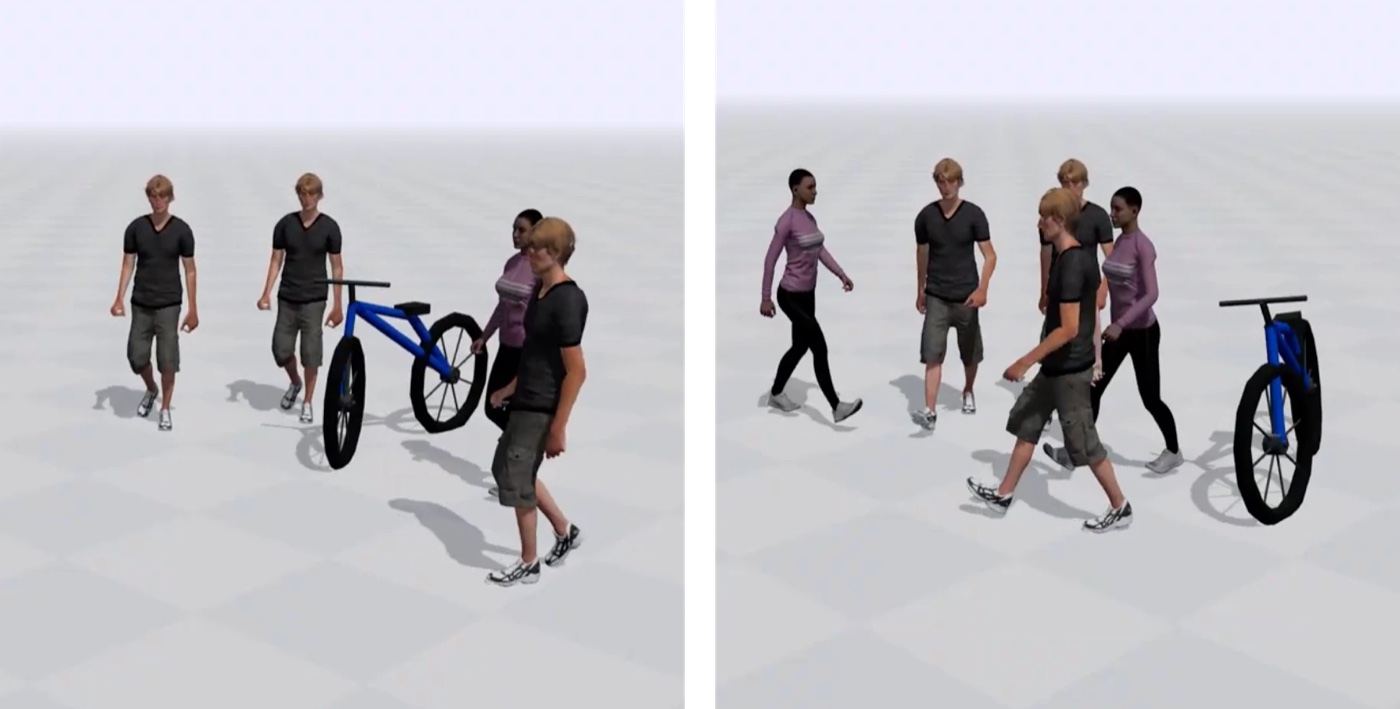
Differentiable Dynamics for Autonomous Micro-Mobility Navigation
IEEE/RSJ International Conference on Intelligent Robots and Systems (IROS), 2026
Project Page / Paper / Poster
Autonomous micro-mobility vehicles (MMVs) such as wheelchairs, scooters, and bicycles have the potential to improve mobility access and support safe low-speed transportation in pedestrian-shared spaces. Achieving MMV autonomy will require realistic, predictable MMV motion. However, many existing autonomous vehicle stacks rely on simplified kinematic models that fail to capture key MMV characteristics such as tire slip, friction, and wheel layouts, limiting realism and gradient-based optimization. In this paper, we explore differentiable formulations of dynamics models for autonomous micro-mobility systems. We first construct DiffKBM, a differentiable version of the classical kinematic bicycle model (KBM). Then, we introduce DiffGM3, a differentiable formulation of the General Micro-Mobility Model (GM3), a unified tire-based dynamics formulation for micro-mobility vehicles that supports a wide range of MMV configurations. DiffKBM and DiffGM3 enable end-to-end differentiable optimization through MMV dynamics, making them suitable for integration into differentiable autonomy stacks. We evaluate these dynamics models in both open-loop and closed-loop settings: (1) open-loop trajectory matching, where DiffKBM and DiffGM3 are integrated as a dynamics layer within DiffStack and optimized to reproduce real-world MMV trajectories, and (2) closed-loop autonomous navigation, where DiffKBM and DiffGM3 are paired with a differentiable model predictive control (MPC) controller in CrowdNav pedestrian scenarios. In the open-loop setting, DiffGM3 outperforms DiffKBM in reproducing trajectories with improvements in ADE and NLL across bicycle, scooter, and motorcycle modes, and reductions in planning loss for bicycle and motorcycle trajectories. We also find that, in closed-loop settings, DiffGM3 improves on DiffKBM's CrowdNav performance by producing 55% fewer collisions and a 75% lower discomfort frequency for the bicycle mode.
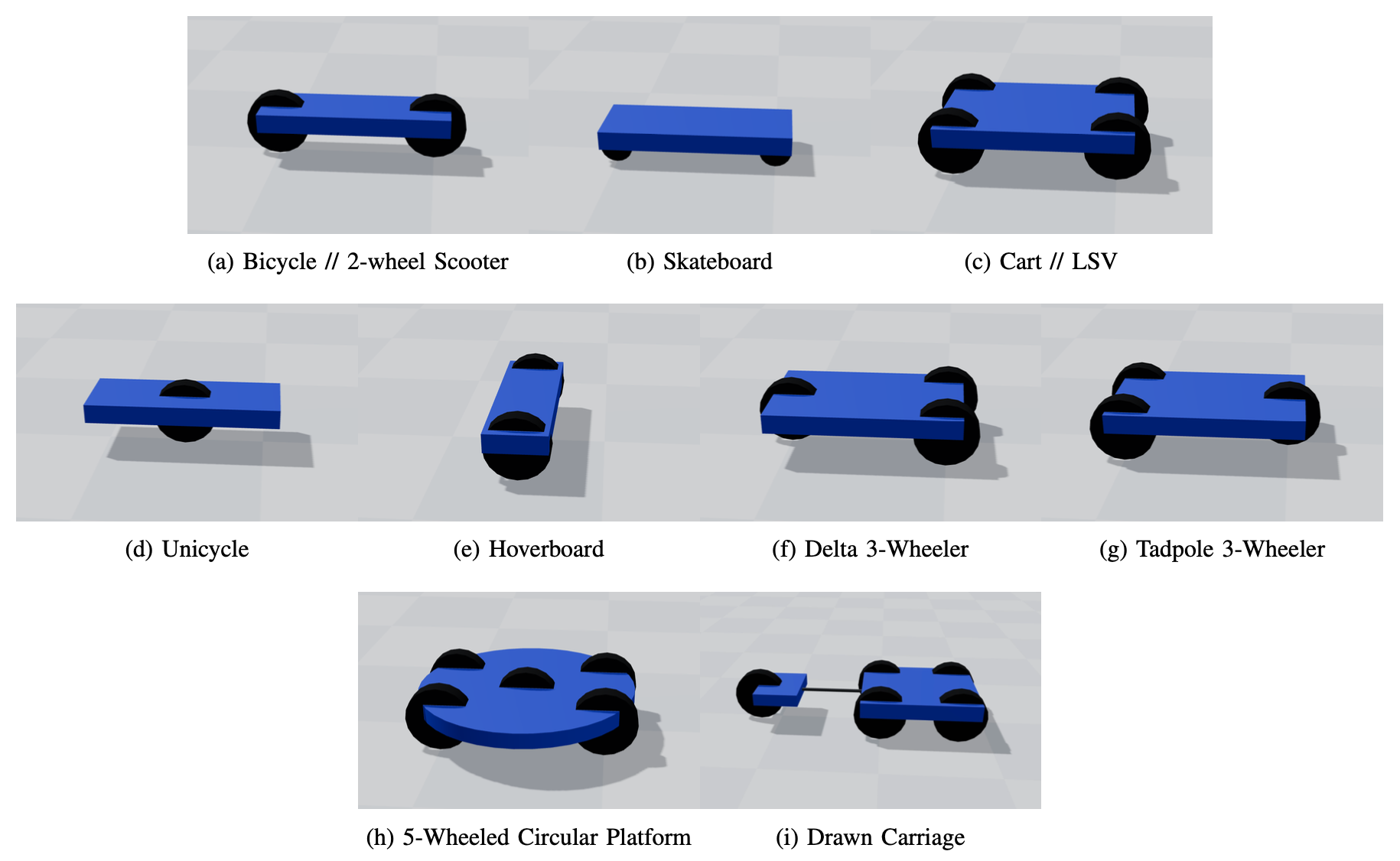
GM3: A General Physical Model for Micro-Mobility Vehicles
IEEE International Conference on Robotics and Automation (ICRA), 2026
Project Page / Paper / arXiv / Video / Poster
Modeling the dynamics of micro-mobility vehicles (MMV) is becoming increasingly important for training autonomous vehicle systems and building urban traffic simulations. However, mainstream tools rely on variants of the Kinematic Bicycle Model (KBM) or mode-specific physics that miss tire slip, load transfer, and rider/vehicle lean. To our knowledge, no unified, physics-based model captures these dynamics across the full range of common MMVs and wheel layouts. We propose the "Generalized Micro-mobility Model" (GM3), a tire-level formulation based on the tire brush representation that supports arbitrary wheel configurations, including single/double track and multi-wheel platforms. We introduce an interactive model-agnostic evaluation and visualization framework that decouples vehicle/layout specification from dynamics to compare the GM3 with the KBM and other models, consisting of fixed step RK4 integration, human-in-the-loop and scripted control, real-time trajectory traces, and logging for analysis. We also empirically validate the GM3 on the Stanford Drone Dataset's deathCircle (roundabout) scene for biker, skater, and cart classes.
Work Experience
Evaluating LiDAR sensor capabilities in NVIDIA Isaac Sim and generating digital twins of mechanical parts for a part database.
Developed MagLev workflows to quantify how sensor degradation affects obstacle perception performance. Built an interactive dashboard to compare feature-level performance across sensor configurations, and implemented an AI agent that investigates failures and generates analysis reports.
Implemented multimodal support in Go and Python to analyze images for privacy risks, increasing recall by 25%. Extended the benchmarking suite to assess accuracy and built a multimodal RAG pipeline to semantically retrieve images using a vector database.
Built a proof-of-concept LLM document summarization tool with Python, Streamlit, and LangChain, and integrated it into an internal document review platform using Go, TypeScript, and React.
Honors & Awards
- Computing Research Association (CRA) Outstanding Undergraduate Researcher Award, Honorable Mention2026
- Excellence in Research Award, University of Maryland2026
- CS Departmental Honors, University of Maryland2023–2026
- President's Scholarship, University of Maryland2023–2026
- Dean's List, University of Maryland2023–2026